
Stable Sit to Stand Motion for an Exoskeleton.
Summary.
This is a project that resulted in a first author journal paper published on IEEE Access. The goal of the project was to achieve user friendly robust sit to stand motions for an exoskeleton, Atalante. For simplicity, we divide the sit to stand algorithm into three sections: modeling the exoskeleton + user system (exo-system), generating the motion, and executing the motion. It is important to note that the algorithms developed can be used for actuated exoskeletons and bipedal robots.
The main contributions of this work are highlighted below using the contributions section of the paper.
For more details please see the abstract to the right or the published paper.
-
Lower-limb exoskeletons provide people who suffer from lower limb impairments with an opportunity to stand up and ambulate. Standing up is a crucial task for lower-limb exoskeletons as it allows the user to transfer to the exoskeleton from a wheelchair, with no assistance, and can be a precursor to walking. Achieving a safe sit-to-stand motion for the exoskeleton + user system can be challenging because of the need to balance user comfort while respecting hardware bounds and being robust to changes in the user characteristics and the user’s environment. We successfully achieve safe sit-to-stand motions by using constrained optimization to generate two types of dynamic sit-to-stand motions based on two hybrid system descriptions for the exoskeleton, Atalante. Due to the highly constrained nature of the equations of motions, we introduce a method to systematically design virtual constraints for highly constrained systems. We also design two quadratic program-based computed-torque controllers to achieve the sit-to-stand motion and to safely come to a stop in a standing position. We then analyze the closed-loop behaviors of the two sit-to-stand motions under the two controllers using physically motivated robustness tests. The criteria used to determine a successful sit-to-stand motion are: tracking error, the pitch acceleration of the torso, the amount of user force needed to perform the motion, and the adherence to the Zero Moment Point (ZMP), friction, and joint constraints.
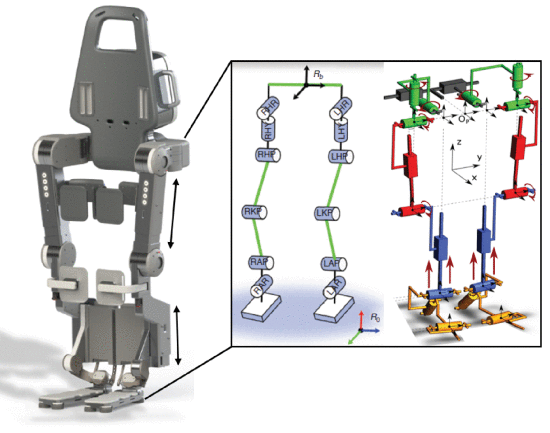
Modeling the Exo-System
“Our Contributions: Modeling the sit-to-stand motion using the full 3D exo-system.
Literature: Only the sagittal plane portion of the sit-to-stand motion is captured, which leaves out the torque requirements on actuators in the frontal and transverse planes.” [1]
Image description: “kinematic architecture of Atalante”[1]

2. Generating the Motion.
“Our Contributions: An analysis of two types of dynamic sit-to-stand motions, chair-to-stand and chair-to-crouch-to-stand, based on hybrid system models and constrained optimization. The two motions are similar when the exo-system is sitting in the chair but differ when the exo-system is off the chair. The chair-to-stand motion simultaneously extends the joints and shifts the CoM forward, while the CoM is first shifted forward and then the joints extended in chair-to-crouchto-stand. The chair-to-stand motion is symmetrical and consists of motion mainly in the sagittal plane.
Literature: The motions are generated for a simplified model of the exo-system. While both quasi-static and dynamic motions are studied, the dynam
Note that static motions require intermediate poses to be stable throughout the standing motion while dynamic motions are continuous and not don’t have intermediate stable poses. “[1]
Image description: The hybrid system models of the two dynamic sit-to-stand motions. For more details please see the paper. [1]

3. Executing the Motion
“Control Objectives:
Our Contributions: We provide a novel and systematic way of choosing the control objectives for highly constrained systems in such a way that the objectives are not in conflict with the contact constraints. Since the resulting closed-loop system is underdetermined (aka, over actuated) and must satisfy real-time constraints on joint limits, torque bounds, and ground reaction forces, we combine quadratic programming with input-output linearization (QP I/O) to (robustly) achieve the sit-to-stand motion and to safely come to a stop.
Literature: To the best of our knowledge, there currently isn’t a way of systematically choosing control objectives for highly constrained systems. When we use the control objectives in [10], [14], [16]–[19], [22], [28], [49] and a QP-enhanced input-output linearizing controller from [10], [19], we find that a 0.02 m increase in chair height results in foot contact violations of over 100 N.
Robustness Tests
Our Contributions: Physically motivated perturbation tests that help us analyze and compare the two sit-to-stand motions. In our tests, we subject our controller to the following perturbations: different users in the exoskeleton, different chair heights, zero user force, spasticity in the knee joints, and asymmetric motor torque outputs. From these tests we are able to assess ranges of variations in which the exoskeleton can operate. These ranges can be used to inform new hardware design or to further robustify the controller. The main results from the tests are: – It is possible to achieve unassisted sit-to-stand motions that meet user comfort constraints. However, we forgo this approach because the inclusion of user force gives the user confidence.
– The chair-to-stand motion is better at handling changes in the chair height.
– The chair-to-crouch-to-stand motion is better at rejecting perturbations that result in asymmetry such as spasticity in the knee joints, and asymmetric torque outputs
– Both motions are equally capable of handling different users in the exoskeleton.
Literature: The robustness tests do not cover the user or their affordances. “ [1]
Image Description: Robustness test results from varying the chair height. For more details please see the paper. [1]
References
M. E. Mungai and J. W. Grizzle, "Feedback Control Design for Robust Comfortable Sit-to-Stand Motions of 3D Lower-Limb Exoskeletons," in IEEE Access, vol. 9, pp. 122-161, 2021, doi: 10.1109/ACCESS.2020.3046446.